
- The European Space Agency (ESA) has tasked Starion, a CS Group company, with studying Saturn’s moon Enceladus to support the planning and design of a future orbiter and lander.
- All available data from previous relevant missions will be identified and analysed to support ESA’s L4 mission, currently proposed for launch in 2042.
- Starion’s experts will also identify locations on Earth with similar terrain and topography to support the mission planning.
Starion España is leading a consortium to initiate the search for data that will provide essential information for a potential future mission to Saturn and its moon Enceladus. ESA chose Enceladus as the top target for its upcoming ‘Large’ class mission because it offers exceptional potential for discovering signs of life. Consortium partners include Starion Italia, with the project providing another example of the specialist expertise being brought together across CS Group Space.
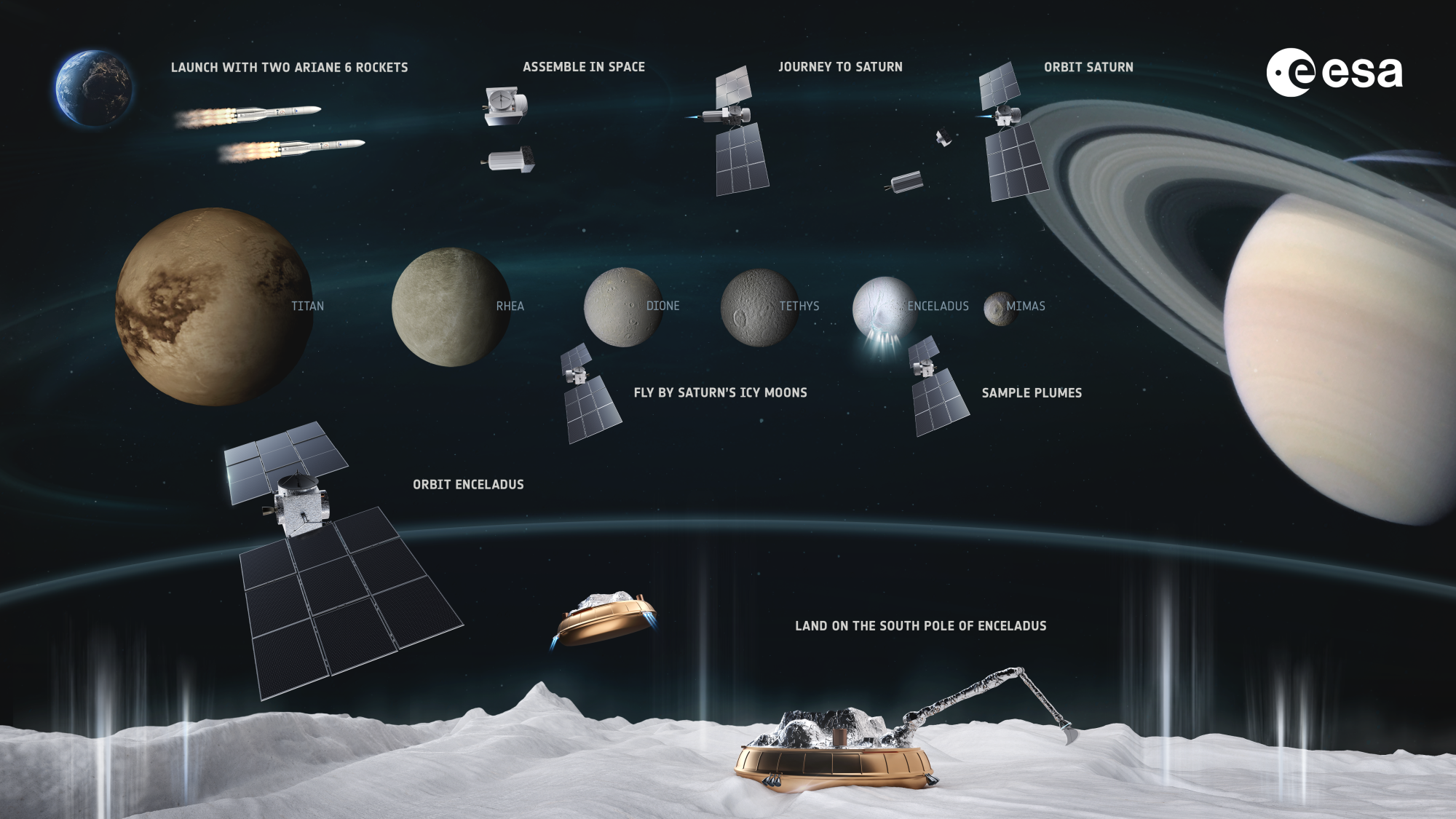
ESA’s L4 mission is still in its early planning stages, which includes assessing options to land on Enceladus. The consortium will process all available data about Enceladus’s environment to inform the planning and design of the proposed mission’s orbiter and lander.
Enceladus is considered scientifically interesting because of its ‘ocean world’ nature. Priorities for the L4 mission, which is the first Large mission of the Voyage 2050 programme, include landing at the south pole of Enceladus and sampling its ‘plumes’ – eruptions of massive geyser-like jets of water and ice particles. However, current knowledge of the moon’s surface is very limited and landing on it is expected to be challenging due to the cryovolcanic environment.
Starion’s team will start by surveying and collecting all existing relevant data sources, algorithms, models and scientific publications, including the extensive data collected by the Cassini-Huygens and Voyager missions that was never fully processed.
The next stage is to develop new processing tools to analyse the data and extract information including plume models, maps, surface temperatures and ice properties. This will be used to assess potential landing sites on Enceladus and identify comparable sites on Earth to support both the scientific and operational aspects of the mission.
Beatriz Martinez, General Manager of Starion España, said: “We’re proud to have been chosen by ESA to take on this task, which will have a significant impact on the future of this exciting proposition for a new planetary mission. Our experts in Spain will employ their extensive experience in working with space science datasets and models at ESA ESAC, and will work closely with our Starion Italia colleagues, who bring expertise in AI and edge computing, to deliver the information that ESA needs for future stages of the L4 mission.”
Enceladus was chosen by ESA’s scientists as the ultimate target for the L4 mission following studies carried out by a multidisciplinary team of engineers at ESA’s Concurrent Design Facility using Starion’s CDP4-COMET model-based system engineering (MBSE) tool. The studies included consideration of the resources that are likely to be available in the 2040s.
Other partners in the project are Italy’s National Institute for Astrophysics (INAF – Istituto Nazionale di Astrofisica) and the University of Sapienza (CRAS).
Find out more
Main image: Artist’s impression of thermal plumes venting from the southern polar region of Saturn’s moon Enceladus. Image credit: ESA/Science Office


