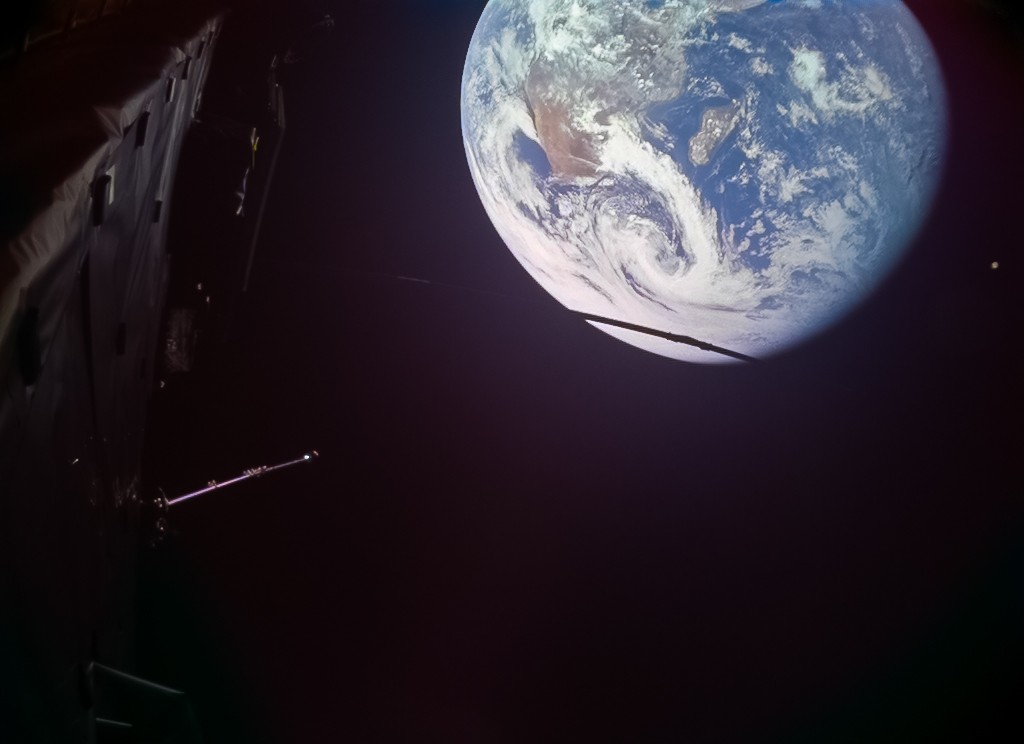
Starion’s engineers at the European Space Agency’s European Space Astronomy Centre (ESA ESAC) have contributed to another successful planetary flyby by ESA’s Jupiter Icy Moons Explorer (Juice) mission during its 8-year journey to the Jovian system. Teams led by Starion engineers supported the planning and execution of instrument observations as Juice passed close by Earth yesterday, and helped it avoid collisions with orbiting satellites.
 Following several months of preparation, Starion’s experts at ESA’s ESAC in Spain were celebrating yesterday when ESA’s Juice successfully passed close by the Earth during its journey to the largest planet in our solar system. Starion-led teams contributed to the planning of how Juice’s instruments would be used during the flyby and its final trajectory.
The flyby of the Earth was one of several planned planetary flybys during Juice’s long journey to Jupiter. These each provide a slingshot effect, or ‘gravity assist’, that together contribute to a fuel-efficient way for the spacecraft to reach Jupiter – a trip that would otherwise require an enormous amount of fuel. These flybys also provide an opportunity to operate Juice’s instruments, helping scientists to calibrate them before Juice reaches its final target, as well as enabling them to carry out scientific observations of the planets they pass.
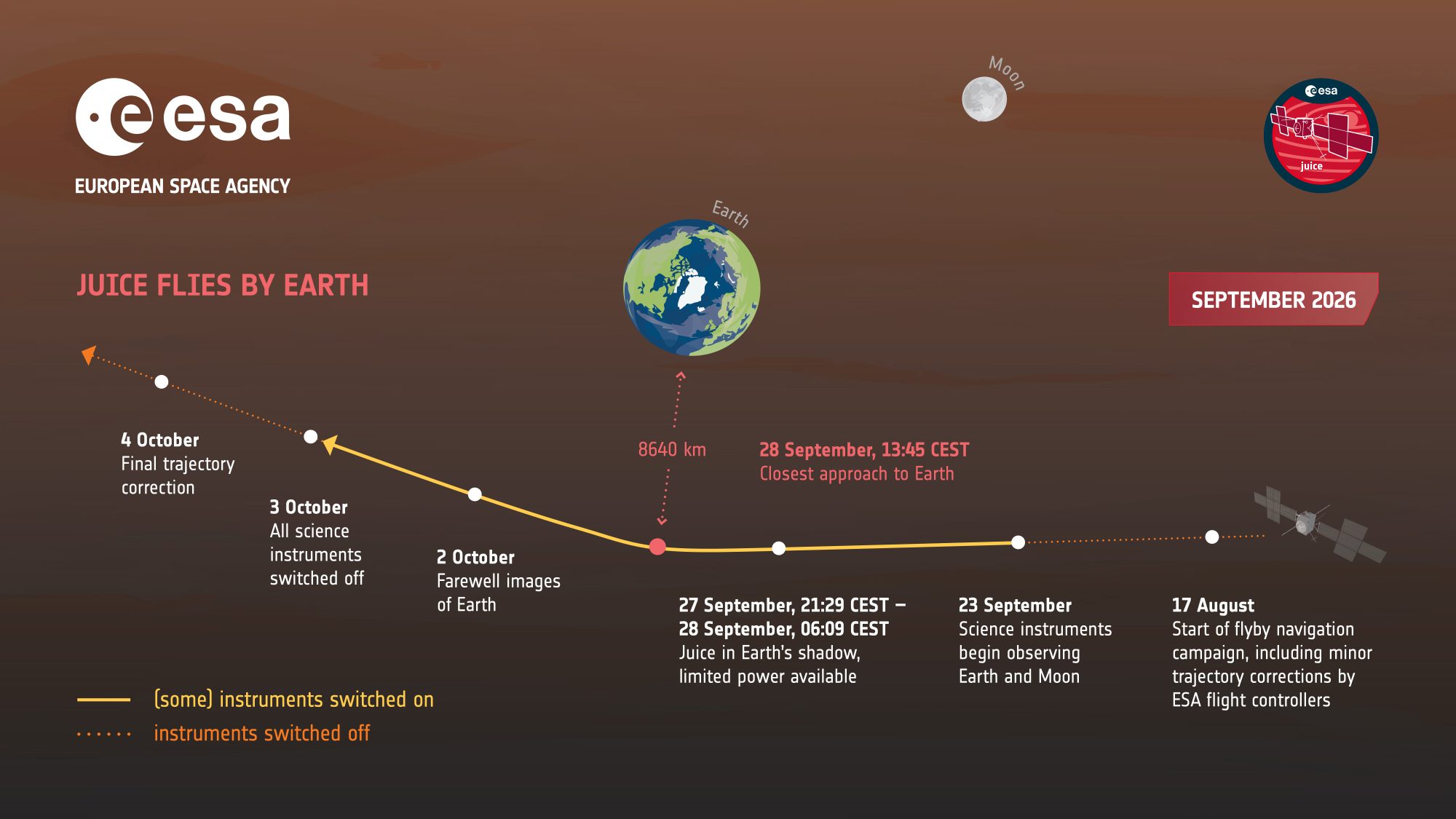
Juice’s instruments will spend several days taking observations of the Earth and Moon during this Earth gravity assist (EGA) event, remaining operational until 3 October. The spacecraft is being turned in different directions during the flyby to point the science instruments at different targets.
At its closest approach, Juice was just 8,640km from Earth, which is much closer to our planet than the orbit of geostationary satellites (35,786km). This added an extra dimension to the flyby planning because the spacecraft had to avoid nearby satellites operating in medium Earth orbit.
Starion-led support services
Starion’s Alfredo Escalante Lopez leads the SPICE team based at ESAC that helped with the planning of observations during the flyby and with identifying the positions of relevant satellites.
“We took predictions from the flight dynamics team about the trajectory and attitude during the flyby and converted these into a specific data type called SPICE. That data was then used by the instrument teams and the SOC [Science Operations Centre] to plan each instrument’s observations and create the commands to make those happen. For example, what we provided helped them understand which regions of the Earth would be visible and which would be in daylight.
“In addition, knowing which satellites would be nearby not only helped to avoid any collisions but also provided an opportunity to plan coordinated observations with satellites carrying different instruments, providing a unique scientific opportunity.”
Starion’s engineers supported ESA and the principal investigators (PIs) for each instrument with the planning of observations in other ways too.
Pilar Esquej, Juice Science Operations Engineer, explains: “There are physical constraints that prevent all the instruments on Juice from carrying out their PIs’ preferred observations at the same time during a flyby. So, several months before a flyby, ESA and the PIs meet to agree on priorities and discuss what is possible. We participated in these meetings to help with investigations, and then with the coordination and delivery of information to the flight dynamics team in the Mission Operations Centre (MOC) at ESA’s European Space Operations Centre [ESOC], which led to the final agreed timeline for all the observations.
“Later in the process, we received and validated the detailed files created by the PIs and their team, which were passed to the MOC for the final validation before sending the telecommands to the spacecraft.”
What happens next?
Juice will return for another Earth flyby in January 2029. In the meantime, Starion’s specialists and their colleagues will be analysing the results and the planning process of the 2026 flyby to identify any potential improvements or modifications.
In addition, they have already started preparing for Juice’s next ‘checkout’ in 6 months, when the instruments will be switched on for their regular biannual checkup.
Find out more
Modelling potential flyby observations
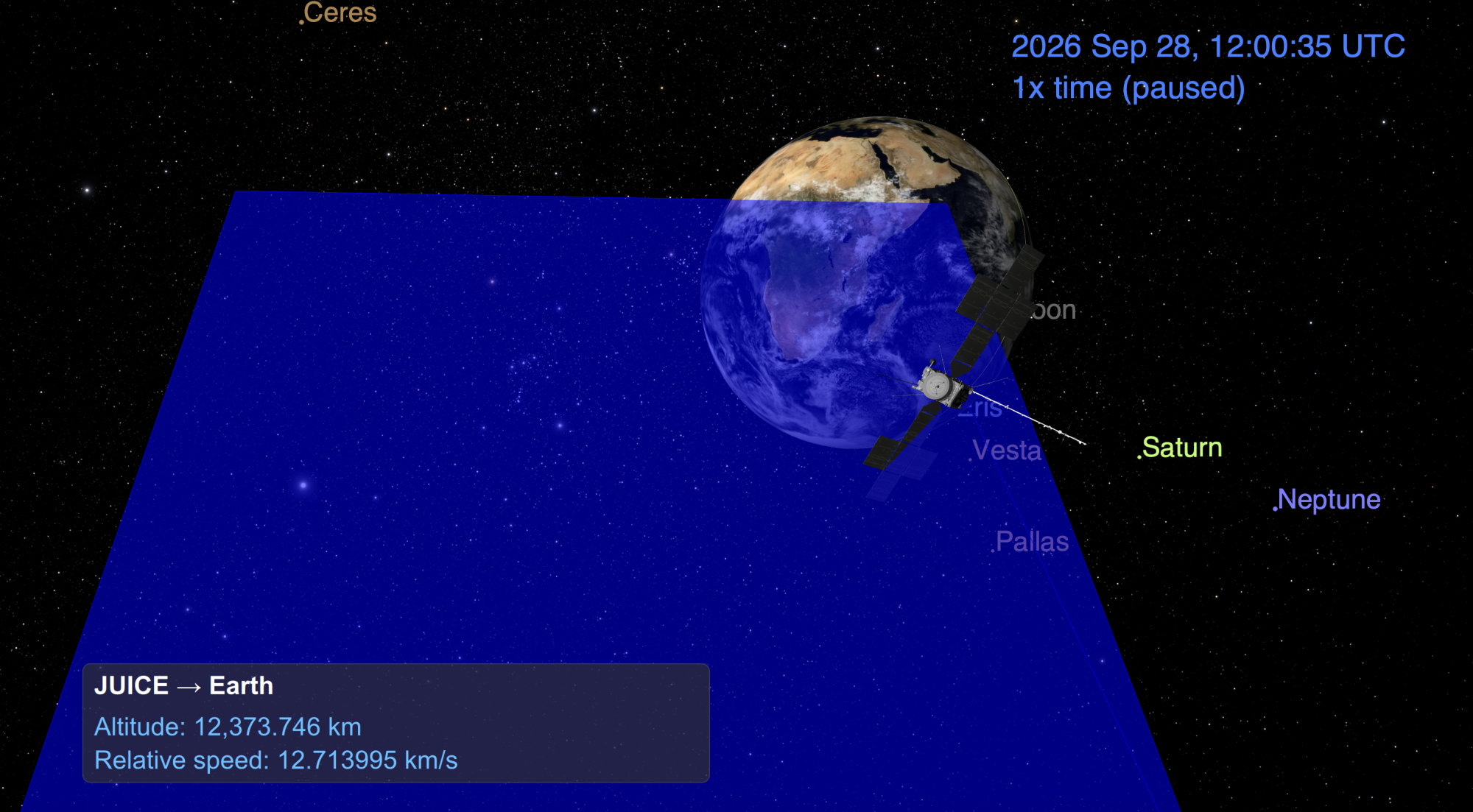
SPICE data was used to model potential observations by Juice’s instruments during the Earth flyby. For maximum accuracy during the manoeuvre, the spacecraft remained in the same inertial position, only changing orientation when well away from the Earth: for example to view the Moon.
The planned change in Juice’s path due to the Earth gravity assist, and the proximity to Earth compared with GNSS constellations (approximately 19,000-24,000km), can be seen in this video:
About Spice
SPICE is a recognised standard for geometric data. SPICE format data can be processed using a collection of SPICE tools.
SPICE is needed because in a space mission there are many sources of data related to the spacecraft and where it is located, and these come in different formats. These include blueprints of the spacecraft, instrument models from the instrument teams, orbit and attitude predictions from the flight dynamics team, data about solar system bodies, and so on. The SPICE service at ESAC, led by Starion, takes all this data and converts it into the SPICE format.
This SPICE data can then be processed using a collection of SPICE tools to get any kind of geometric information about a mission. A scientist can use this, for example, to find out if and when a specific target will be the field of view of their instrument. Starion’s team provides support to those using the SPICE tools or requiring specific SPICE calculations.