Case study: International Use Cases for Operational QKD Applications and Services
The International Use Cases for Operational QKD Applications and Services (INT-UQKD) project, managed by Starion, is developing operational quantum-safe communications capabilities in international IT environments. This includes implementation of quantum key distribution (QKD) networks connecting Luxembourg, Belgium and Singapore.
The definition and validation of use cases is expected to guide future international QKD solutions, with a focus on digital sovereignty, interoperability between infrastructures and strategic autonomy. Creating real-life operational demonstrations helps with the assessment of technology and security compliance, and identification of related policy requirements.
INT-UQKD is funded by the European Space Agency (ESA) under the Advanced Research in Telecommunications Systems (ARTES) R&D programme. (See below)
Timeline and milestones
- September 2022 – INT-UQKD project launched in Luxembourg
- August 2023 – Deployment of the terrestrial segment between Belgium and Luxembourg: in continuous 24/7 operation ever since
- November 2024 – Demo 1: Public demonstration of quantum-safe applications secured by the operational QKD terrestrial network between Luxembourg and Belgium. Demonstrated the capability to deploy business-oriented applications targeting commercial application for regulated markets (e.g. finance and energy distribution)
- November 2025 – Launch of the SpeQtre satellite that will be used to build the space segment of the hybrid QKD network, demonstrating intercontinental quantum-safe communications as part of the INT-UQKD project
- June 2026 – Start of 3-year project extension in Belgium focusing on quantum communication infrastructure (QCI) interoperability and resource management
- June 2026 – Unveiling of the optical ground station (OGS), designed by HITEC Luxembourg, to be used at the European end of the INT-UQKD space segment
- 2026 – Demo 2: Demonstrate Luxembourg–Singapore use cases employing a hybrid space–terrestrial network established through fibre-based and satellite communication infrastructures
Stakeholders
Starion Luxembourg is managing the INT-UQKD project and acting as solution architect and system integrator. Project partners are:
- Luxembourg – POST Luxembourg, the University of Luxembourg’s Interdisciplinary Centre for Security, Reliability and Trust (SnT), HITEC Luxembourg
- Canada – evolutionQ
- Singapore – SpeQtral
- Belgium – Starion Belgium, Nexova, IMEC, AMOS, Royal Military Academy of Belgium
Other stakeholders include: ESA, Luxembourg Space Agency, Belgian Science Policy Office (BELSPO), Canadian Space Agency (CSA), National Space Agency of Singapore (NSAS), Belnet and IDELUX.
Objectives
The primary objective of the INT-UQKD project is to enable quantum-safe communications links for specific use cases in operational IT environments – particularly in regulated sectors that have very strong security requirements – and to demonstrate the technology’s maturity for commercial use.
Cryptography is essential to protect communications and safeguard data. Many existing cryptographic techniques that underpin today’s global communications networks will soon be at risk due to the development of large-scale quantum computers. New quantum-safe technologies need to be developed and validated to safeguard critical data communication services and IT infrastructures in the post-quantum era.
Innovation and implementation
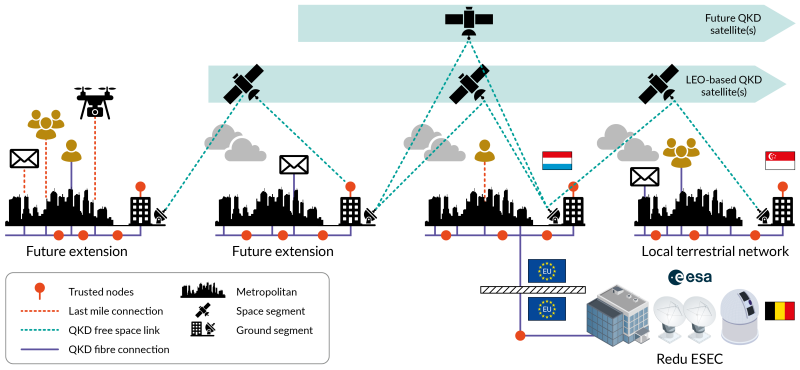
The INT-UQKD project is designed to be quantum-safe across a wide range of interconnected networks and integrated with existing ‘last mile’ local networks. It combines terrestrial and satellite QKD solutions with post-quantum cryptography (PQC) elements to provide a secure, resilient communications solution:
- The terrestrial links leverage existing optical communication infrastructures to securely exchange encryption keys between two or more locations.
- The space segment will operate through low Earth orbit (LEO) satellites capable of exchanging keys across continents through free space optical quantum channels.
- PQC connectivity to remote endpoints will enable secure connectivity using classical communication channels (such as 5G/6G, RF link or ethernet).
Together, this creates a network of interconnected trusted nodes from which a wide range of security services are established. The INT-UQKD system architecture and service delivery is infrastructure agnostic, allowing future quantum-safe extensions to enhance technical capabilities and expand the network geographically.
INT-UQKD’s hybrid approach ensures resilience by removing any single point of vulnerability. PQC and QKD are based on entirely different principles and the types of threats facing them are distinct. This ensures that any threat targeting either QKD or PQC will not critically impact service delivery security: an adversary would need to master and simultaneously exploit potential vulnerabilities within both PQC and QKD to succeed.

Results and impact
Quantum-safe communications links have been demonstrated successfully by INT-UQKD over existing terrestrial optical fibre networks, with a terrestrial QKD link operating continuously between Belgium and Luxembourg since 2023. The next step is to complement the capabilities of INT-UQKD with satellite-based QKD, enabling very secure communications over long distances that would not be economically feasible over terrestrial networks. This will be demonstrated in 2026 for the first time.
Through practical, business-focused demonstrations, INT-UQKD is generating valuable insights for commercial stakeholders aiming for rapid market entry and long-term sustainability of quantum-safe technologies, products and services tailored to the needs of institutional, corporate and individual users.
The project is also playing a critical role in evaluating and validating future technology options, ensuring compliance with post-quantum security standards, and guiding European Union (EU) policymakers in shaping strategies for quantum communications and quantum information networks.
What’s next?
The INT-UQKD team is developing, in parallel, Belgian and UK extensions to the project. In addition, it is preparing the end-to-end validation of the inter-continental infrastructure using the SpeQtral space segment.
The primary focus of the new extension in Belgium is interoperability between independently developed quantum communication infrastructures (QCIs) using INT-UQKD network components. The project consortium will develop and prove the security and operational capabilities of a service component that can enable resilient key establishment across the INT-UQKD network and BENELUX-QCI, a joint initiative by Belgium, the Netherlands and Luxembourg. This will then provide the foundations for a future standard for interconnection between any QCIs.
Notes
Funding
INT-UQKD is funded by ESA under the ARTES R&D programme and managed by the Optical and Quantum Communications – ScyLight SPL. It is supported by the Luxembourg Space Agency (LSA) with extensions additionally supported by the Belgian Science Policy Office (BELSPO).
Find out more
You can find out more about the INT-UQKD project and funding at: