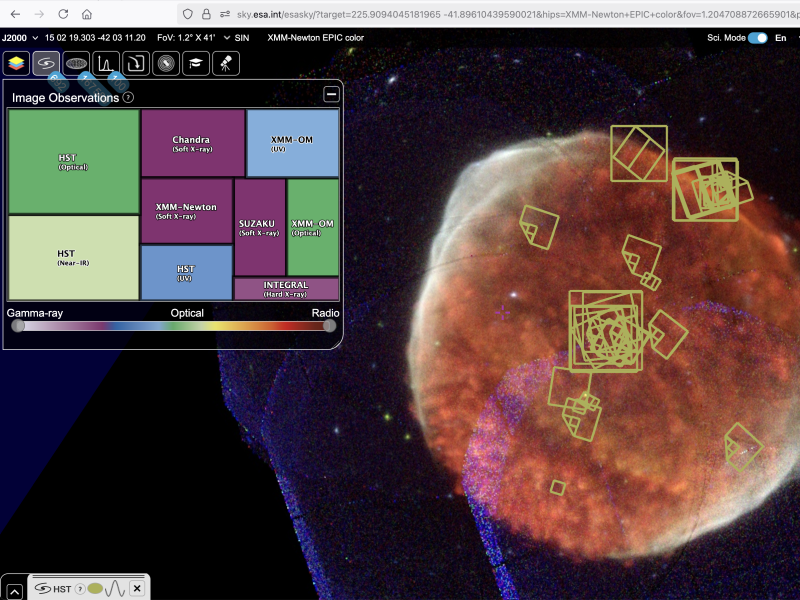
 At the European Space Agency’s European Space Astronomy Centre (ESA ESAC) in Spain, Starion’s space science experts research and develop a wide range of applications and tools related to solar system exploration. Among these are virtual and augmented reality applications designed for both science operations and outreach purposes, which includes introducing the amazing world of space science missions to younger generations.
Starion’s Christian Perez Nicolas, CESAR IT Engineer, explains the benefits of the virtual and augmented reality tools developed with Alfredo Escalante Lopez, Spice Work Package Manager at ESA ESAC.
What projects does Starion work on at ESAC?
Starion’s experts lead a number of key activities at ESAC, including development of planning software used for science operations in planetary missions such as ExoMars, BepiColombo and JUICE, and operations of the ESAC Science Data Centre (ESDC) and the space science archives. We also lead the Cooperation through Education in Science and Astronomy Research (CESAR) educational programme for ESA.
The last of these is a joint venture by ESA, Spain’s National Institute for Aerospace Technology (INTA) and Engineering Systems for Defence of Spain (ISDEFE), which aims to promote interest among schoolchildren in astronomy and space through educational scientific resources and experiences.
What can virtual reality provide in a space science context?
Virtual reality (VR) technology offers great potential for both operational and educational purposes. Some of the hardware is now so powerful that even affordable standalone devices can provide highly realistic immersive experiences, delivering new and innovative ways to learn and collaborate. In a business context this can accelerate design and prototyping, while for education, it helps to make abstract concepts more tangible.
Some of the applications we’ve developed involve the visualisation and manipulation of complex systems. Others are focused on science and telemetry. We have also created applications for simulated environments and digital twins.
What VR applications have you developed?
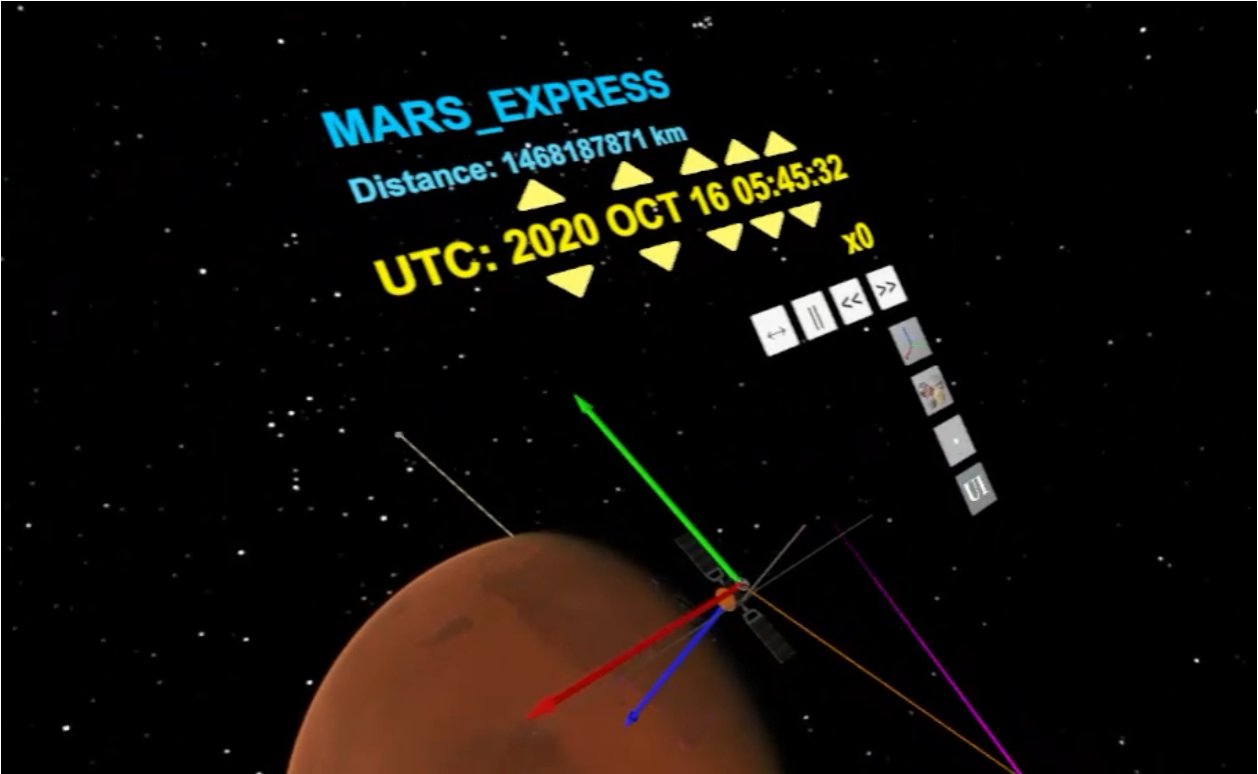
Among the ‘business’ applications for ESA, the team creates 3D visualisations using SPICE data and the Cosmographia tool, which are used to plan and prepare planetary flyby operations and observations. The motivation for this is that in a 3D environment you can better understand what is happening when spacecraft are doing flybys.
In terms of educational projects, one of the team’s first projects was the ‘ESA Museum’, a VR experience that allows students and teachers visiting ESAC to move through virtual rooms featuring information about the sun and the planets. (See below.)
Another provides an interactive experience based on the surfaces of the Moon, Mars and Jupiter’s moon Europa. Students can move around freely and get information about the science of each solar system body from various information points.
One more that we have developed is a tool that shows children how big a satellite really is by setting it in the context of the ESAC grounds when they visit. This provides a practical alternative to actually building and maintaining large, complicated physical models.
Where next?
For the ESA Museum, we’re planning to upgrade the graphics to enhance the overall user experience and implement new models of the Science Satellite Fleet (Scifleet) spacecraft. Alongside this, we’d like to create augmented reality tours of other ESA installations.
Another plan is to deploy the existing apps onto other platforms, including smartphones, to make them more widely available. There’s a lot of optimisation involved, so we’re developing artificial intelligence (AI) tools to help with this aspect.
In addition to standalone applications, we’re implementing multi-user functionality so that many people can experience the same application at the same time: for example as part of the concurrent design process.
An augmented reality viewer for the SMOS mission
 Traditional methods of visualisation, such as computer-aided design (CAD) tools, are limited in terms of accessibility and interactivity, and require specialised software and technical expertise. Augmented reality (AR) can transform the experience by enabling people to visualise a spacecraft in real-world environments in a way that is both immersive and interactive. Users can intuitively explore the spacecraft’s geometry and subsystem layouts, and understand relationships between components in ways that aren’t possible with conventional visualisation methods.
In late 2025, the team working on the Soil Moisture and Ocean Salinity (SMOS) mission, one of ESA’s Earth Explorers, asked us to create an AR model of the spacecraft. Our team started by reducing the original 80Gb 3D model to 8Mb so that the application could run entirely within the VR headset, with no extra hardware or software, no cables and no access to the internet.
The model includes more than 350 objects, plus the satellite’s cabling harness, using high resolution textures to ensure the best possible accuracy. Within the AR view, you can take the satellite apart to see each component, all of which are labelled.
Everything can be controlled by gestures, including grabbing objects. Using this approach, rather than having visible buttons, enhances the sense of reality and makes it as easy as possible to use. It even includes voice recognition for some controls.
Finally, you can alternate between AR and VR to swap between views of the satellite components and the satellite in orbit.
Further information
- The CESAR project, including activities and tools: cesar.esa.int/
- SPICE and Cosmographia
- Starion and the ESA space science archives