
In this series of blog posts, we’re shining the spotlight on some of the behind-the-scenes contributions – both human and technological – that contribute to the success of space missions. This includes tools essential for capturing the data that provides the foundation of many of the important discoveries produced by the European Space Agency’s (ESA’s) science missions.
In this post, we look at the role played by one of the teams working at ESA’s European Space Astronomy Centre (ESAC), who ensure the instruments onboard ESA’s science missions always point in the right direction.
Planetary flybys, or gravity assists, are frequently used to adjust the speed and trajectories of spacecraft to help them to reach their final destinations. They act like a slingshot, typically enabling the spacecraft to use less fuel than would otherwise be required. Sometimes they are employed multiple times in a single mission: BepiColombo, for example, has performed six flybys of Mercury, in addition to flybys of Earth and Venus, on its way to a final stable orbit around the innermost planet in our solar system.
One bonus of these flybys is that they offer the chance to study other planets and their moons on a spacecraft’s route to its final destination. However, during both the nominal mission and special observation opportunities like flybys, the instruments not only need to be operational and receiving commands, they also need to know where to look!
To support this, careful planning is vital to allow scientists to understand in advance what will be in the view of each instrument at any time. For ESA’s planetary missions, this is handled by a team based at ESAC, who support planning for the flybys through their work on the operations of the SPICE geometry system software. The team receives an array of mission-related data, such as trajectory and attitude predictions, in different formats from multiple sources. These are converted into the SPICE format and distributed for use in tools used to prepare flyby operations and observations.
SPICE and Cosmographia
SPICE was originally developed in the 1990s by the Navigation and Ancillary Information Facility (NAIF) at NASA’s Jet Propulsion Laboratory (JPL). Led by the Starion team, SPICE now provides the core of planning tools used for all ESA’s planetary missions, including the Cosmographia visualisation tool, which also originated from JPL’s NAIF.
The SPICE team is responsible for keeping both SPICE data and planning tools such as Cosmographia up to date and making geometry data for planning and analysing operations available to the science community.
“Cosmographia provides a powerful visual way to view the geometry data for missions such as Solar Orbiter as it holds both ‘flown’ telemetry data downloaded from the spacecraft and ‘planning’ or ‘predicted’ data. This lets users see how the spacecraft’s trajectory will change over time. More importantly, they can also use it to display the field of view of each instrument. For Solar Orbiter, for example, it enables them to plan an observation of a specific region of the Sun. It can also be used to see the position of spacecraft components, such as solar arrays and antennas, at any time.” Starion’s Alfredo Escalante Lopez, Spice Work Package Manager at ESA.
Providing SPICE for the Hera flyby
Last year, the SPICE team supported the Hera mission gravity-assist flyby of Mars, because scientists wanted to use the opportunity to study Mars’ moon Deimos from close range and use that to calibrate Hera’s instruments before it reaches its final target of the Didymos binary asteroid system.
In advance of the flyby, the SPICE software operations team took predictions of the spacecraft’s trajectory and attitude from the mission’s flight dynamics team and converted these into the SPICE format. This was then made available to the spacecraft’s instrument teams to help them plan an observation timeline for Hera’s Asteroid Framing Camera (AFC), Thermal Infrared Imager (TIRI) and Hyperscout hyperspectral imager.
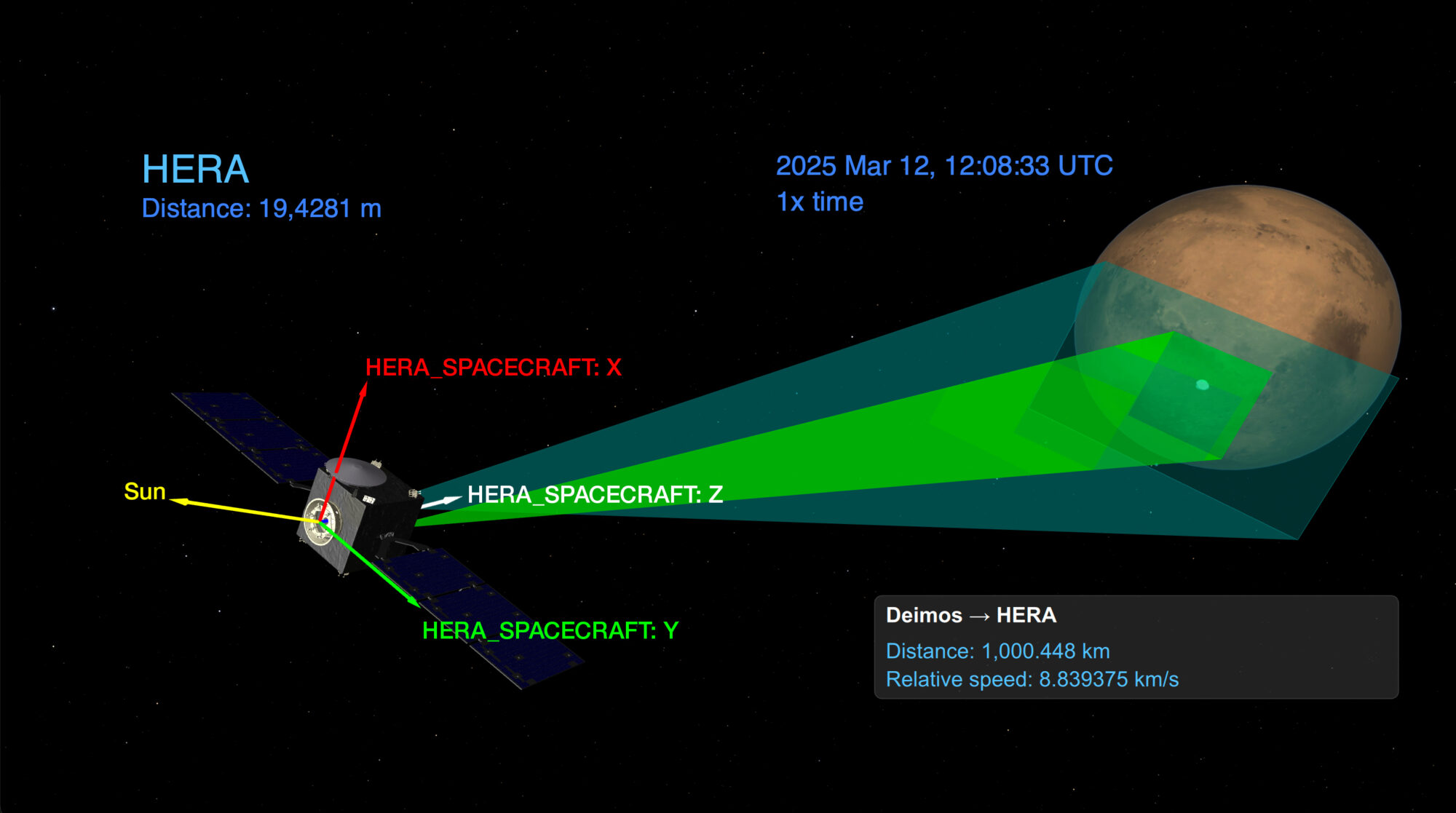
Alfredo Escalante Lopez recounts: “As the flyby happened, we analysed the images in real time, using telemetry and trajectory data given to us by the flight dynamics team, to support calibration of the instruments. By comparing the images with our original simulations made using the Cosmographia tool, we then provided SPICE data kernels to let the instrument teams correct issues such as misalignment or optical distortions that may have been caused by factors such as vibrations during launch, and optimise aspects like the image exposure times. Calibrating the instruments this way before Hera reaches Didymos will let scientists start making observations straight away when they reach the asteroids, saving precious time.”
The use of SPICE is not limited to ESA missions. The SPICE service team has also been using it for constellation mission analysis prior to the launch of any of the satellites.
Find out more
This is an extract from the latest issue of OpenSpace magazine. Subscribe to read other in-depth articles on space weather and civil security from space, plus an interview with the Director of the Spanish Space Agency.
About SPICE and Cosmographia
Find out more about SPICE and the ESA SPICE Service
The SPICE-enhanced Cosmographia tool is freely available for download, along with the required catalogue files for each mission, including Hera, at: cosmos.esa.int/web/spice/cosmographia
Simulation of Hera’s instrument’s field of view during the Mars/Deimos flyby using the Cosmographia tool


