
The growth of digital twin applications has been significantly driven by advances in big data and artificial intelligence (AI). They now provide powerful tools for simulating, analysing and optimising real-world systems in virtual/hybrid environments. In this extract from OpenSpace magazine, we look at how they are being used in a range of scenarios, making real-world differences.
What is a digital twin?
The first practical definition of a digital twin originated from NASA in an attempt to improve physical model simulation of spacecraft in 2010 – it believed a digital twin can be defined as a model-based approach with digital implementations.
Today, the definition of a digital twin varies depending on who you are talking to, the market it is used in, what it is created to represent and the intended use. It can be a simulation or emulation of a system that is updated with data from the operation of that system and therefore works as a twin of the real system. In recent years, people have started calling a broader set of models, simulations or emulations “digital twins”, but this is incorrect. A digital twin must be supplied with the relevant data to enable it to represent the full life cycle of a product or system, updating continuously via real-time data feeds.
Emulation vs model-based digital twins
There are two common approaches for digital twins: emulation-based and model-based, each offering distinct advantages.
Emulation-based digital twins aim to replicate real devices, systems and networks with high fidelity, enabling a true-to-life digital environment. Their ability to interact dynamically with changing conditions makes them ideal for real-time testing, development and operational analysis.
The strength of emulation-based twins lies in their precision and responsiveness. By mirroring actual hardware and network behaviours, they can deliver detailed and accurate results that closely reflect real-world performance. However, their reliance on high-fidelity emulation can become a limitation when dealing with components or scenarios that are too abstract, too complex or not feasible to replicate directly.
By contrast, model-based digital twins rely on mathematical models and algorithmic representations of systems. Rather than replicating physical components, they simulate behaviours using rules, formulas and assumptions. This approach is suited to scenarios that require abstraction, such as long-term forecasting, optimisation tasks or systems that cannot be emulated efficiently. While this method often results in lower fidelity and less specificity, it offers scalability and computational efficiency, making it essential in many large-scale or conceptual applications.
The most effective digital twin implementations often combine both approaches. Emulation provides depth and realism where accuracy is critical, while modelling offers flexibility and abstraction where needed. Choosing the right balance depends on the goals of the simulation, the nature of the system and the constraints of the environment. Understanding the distinctions between these two approaches is key to building digital twins that are both reliable and fit for purpose.
Digital twins in the space sector
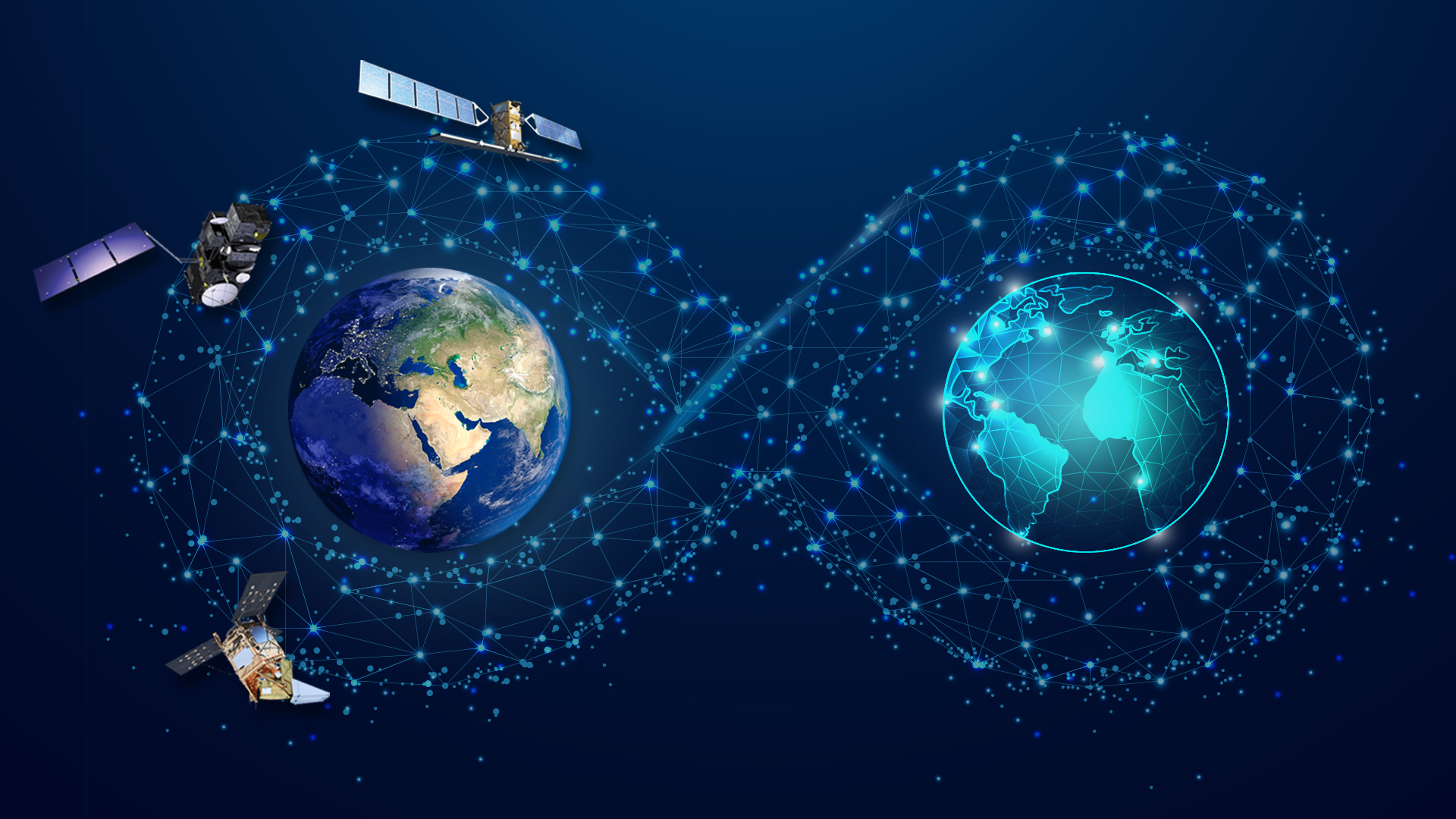
Within the space sector, digital twins can provide a digital representation of the Earth system, spanning scales and domains. They provide users with the capability to monitor, forecast and assess the Earth system and the consequences of human interventions on Earth, and provide decision support systems for addressing environmental challenges.
Digital twins are supporting strategic initiatives such as the European Green Deal, the United Nations Sustainable Development Goals (SDGs) and civil protection efforts by enabling data-driven decisions, optimising resource allocation and fostering collaboration among diverse stakeholders.
In cybersecurity for space, digital twins are used to create safe, simulated environments for real-time training and testing, as well as emulating functionalities that allows organisations to strengthen their defences without risking operational systems.
Destination Earth
In 2021, the European Commission (EC) launched a flagship programme called Destination Earth (DestinE). This offers a highly accurate digital twin of the Earth to model and monitor the effects of natural and human activity on Earth. DestinE utilises an unprecedented amount of data, innovative Earth system models, AI, cloud computing, high-speed connectivity networks and data from multiple existing and new sources.
DestinE is designed to help scientists and policymakers understand the complex interactions that the environment and humans will play in shaping the Earth’s future. It also forms a baseline for effective adaptation strategies in support of the green transition, helping the European Union reach its carbon neutral goal by 2050.
Protecting ESA’s systems
Digital twins are also supporting cybersecurity in the space domain. Matteo Merialdo, Cybersecurity Principal at Starion, has been working with the European Space Agency (ESA) on several projects, and directly on ESA’s cyber resilience for the past 4 years.
“We are investigating with ESA how to best use digital twin technologies to enhance cybersecurity. This could be to deploy a replica of a security operations centre [SOC] into a digital twin environment. Real data from the SOC is mirrored into the twin; this type of capability helps to predict the behaviours of the original system. It can enable operators to train, test new features and systems, and support effective alert handling and threat investigation without affecting live operations.”
Where next?
For ESA, the use of digital twins is expanding beyond operations to support pre-launch phases, providing users with realistic system representations, advanced simulations and predictive insights. In operational contexts, digital twins serve as a valuable tool for mission operators, enhancing situational awareness, validating procedures and supporting decision-making. A digital twin can also be an enabler for embedding AI tools that will leverage quality data and simulation models to provide precise predictions, improving prognostics, health management and assessment of the remaining life of a spacecraft.
Digital twins strengthen digital continuity by enabling more automated and data-driven workflows. They also contribute to mission planning, testing and troubleshooting by offering high-fidelity virtual models that help reduce risks and improve autonomy.
Find out more
This is an extract from the latest issue of OpenSpace magazine. Subscribe to read other insightful articles on space weather, civil security from space and the unsung heroes of space missions, plus an interview with the Director of the Spanish Space Agency.
Images © ESA


