
In May 2024, Earth found itself in the path of the most powerful solar storm to head in our direction for over 20 years. Although the Gannon Storm didn’t cause any major power outages or other serious incidents, over time reports surfaced of a diverse range of impacts. Taken together, these underscore the importance of the many space weather activities currently taking place globally, from studying the Sun to mitigation planning. In this extract from OpenSpace magazine, we explore some of the space weather activities currently underway.
Read the full article and other space and cybersecurity articles in the latest issue of OpenSpace magazine.
The first ‘major’ recorded impact of space weather on technology was in 1859 due to what is known as the Carrington Event – the most powerful solar storm to impact Earth on record. Despite impacts from subsequent solar storms, it took the Halloween storms of 2003 to emphasise just how serious the impacts of space weather could be. Many satellites experienced anomalies, with anecdotal evidence suggesting that the majority of satellites in low Earth orbit (LEO) were temporarily ‘lost’. Aircraft flights were diverted away from the poles to lower latitudes to avoid radiation, there was a power outage in Sweden and GPS systems were seriously affected.
Since then, organisations around the world have set up or enhanced programmes to gather related data in space and on land, and to study the Sun and the effects of its behaviour. The ultimate goal is to create a space weather forecasting system analogous to the terrestrial weather forecasts we now take for granted. In the meantime, we need to continue to improve our ability to mitigate the effects of space weather events.
What’s the problem?
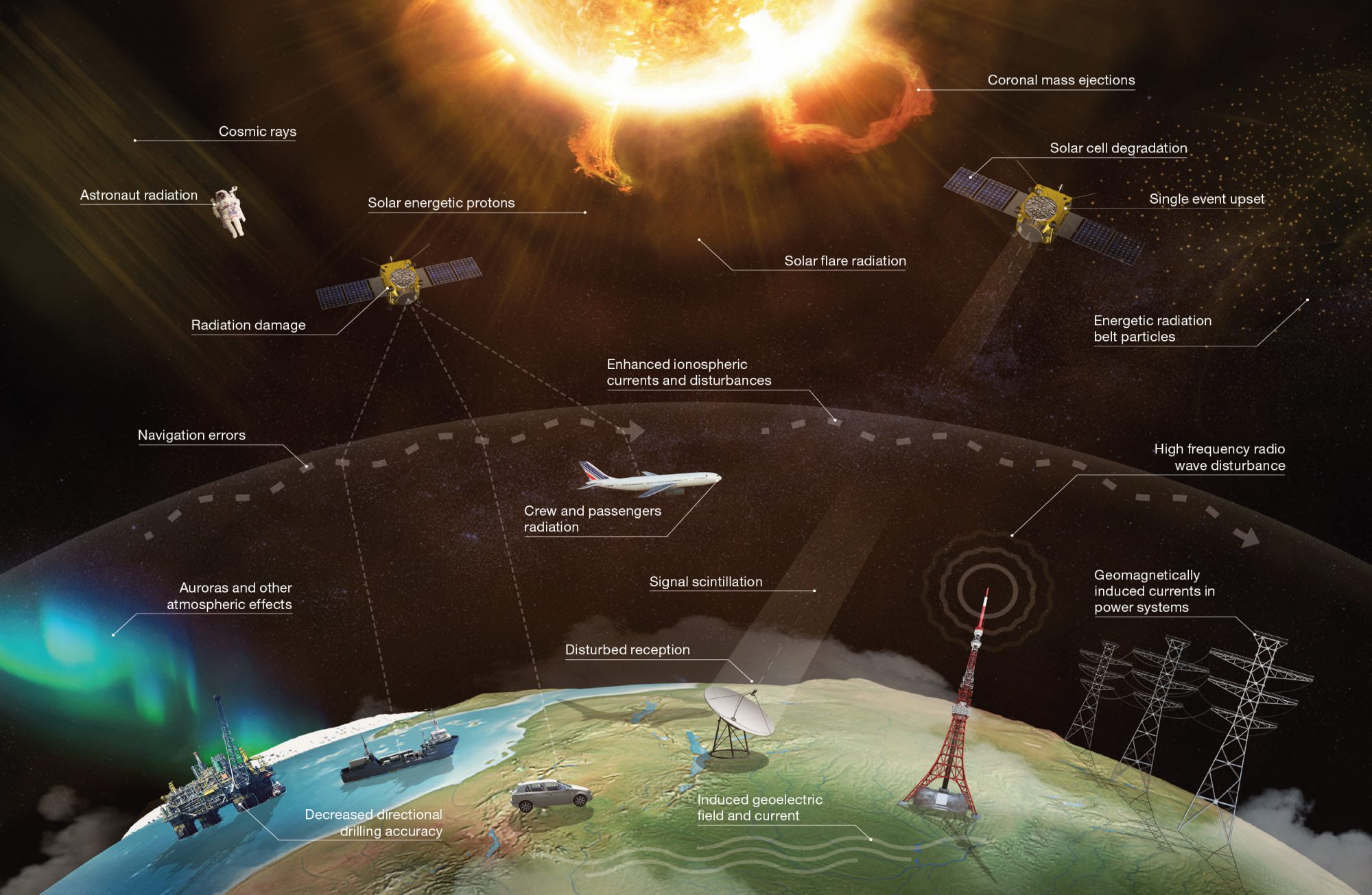
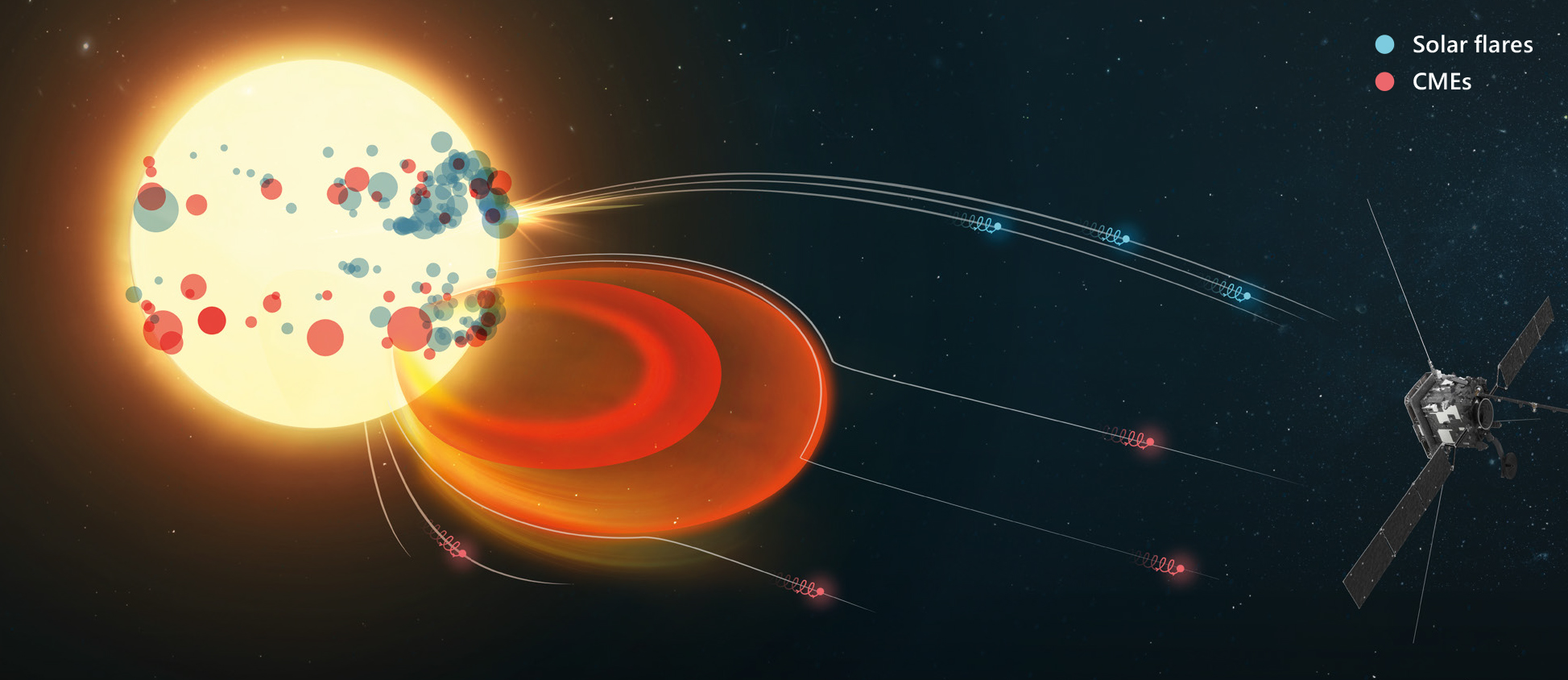
Space weather describes the interaction of phenomena caused by solar activity with the Earth’s magnetosphere, atmosphere and ground, and with technology and engineered systems, such as satellites, aircraft, power cables and electronic systems. Each of the phenomena can cause different impacts, including loss of radio signals caused by solar flares, power outages due to geomagnetic storms emanating from coronal mass ejections (CMEs) and disruption to satellite operations from radiation storms.
There are too many potential impacts of space weather events and mitigating actions to describe in a single article – a report published earlier this year on Severe Space Weather Impacts on UK Critical National Infrastructure, led by Starion as part of the UK’s Space Weather Instrumentation, Measurement, Modelling and Risk (SWIMMR) project, runs to over 100 pages. Lloyd’s, the insurance marketplace, estimates that the global economy could be exposed to losses of US$2.4 trillion over a 5-year period – or up to US$9.1 trillion in the most extreme scenario – from the threat of a hypothetical solar storm.
As a result, there are many projects assessing the threats to space-, ground-, sea- and air-based infrastructures and systems, and potential mitigations.
ESA Space Weather Payload Data Centre
The European Space Agency (ESA) is actively engaged in a broad range of space weather projects and activities. “Space weather has the ability to impact a large number of technologies and systems that form part of our everyday lives, and many aspects of our critical infrastructure,” says Alexi Glover, ESA Space Weather Service Coordinator. “Our Space Safety Programme is developing new sources of data and service capabilities geared towards increasing the resilience of our society to space weather impacts.”
ESA’s projects include the development of the Space Weather Payload Data Centre (SWE PDC), which is being led by Starion. Alexi Glover explains: “The new PDC in development is intended to be a flexible and scalable system carrying out Level-1 data processing for ESA’s space weather hosted payload missions and beyond. In future, the PDC will also support further elements of the Distributed Space Weather Sensor System [D3S] under development, plus the Vigil mission due to launch in 2031.
“The SWE PDC will make processed Level-1 data available in near real-time to the Space Weather Service Network for further Level-2/3 data processing into space weather products. The PDC project will also implement the SWE Data Hub capability, replacing and extending the current Space Weather Database [SWEDB] functionality, enabling the storage, retrieval, analysis and visualisation of data in support of space weather services and their users.”
The PDC will be scalable, secure (zero trust) and cloud native. The project will also include the development of enhancements for the current SWE Data System that supports the ESA Space Weather Service Network. This provides an overview of current space weather conditions and a set of domain-specific dashboards for areas such as spacecraft, aviation, pipeline and power systems operation services. The enhancements will support improved user interfaces and will also provide additional tools to facilitate visualisation and access to ESA Space Weather Network data products that are typically hosted at federated sites operated by organisations across the space weather community.
Underpinning infrastructures
One of the key points made by experts is the need to focus on infrastructures that underpin other critical services, with the primary examples being satellites and power grids.
Given our reliance on satellite-based data and services, it’s essential to understand the risks satellites face from space weather. One is ‘single event effects’ caused by ionising radiation damaging onboard electronics. This can be mitigated to an extent by using radiation-tolerant components, shielding and redundancy in the design, but all of these come at a cost.
Another concern is the increased drag caused by solar flares and CMEs temporarily heating Earth’s upper atmosphere – something that mainly affects spacecraft in LEO, of which there are now many thousands. Increased drag makes satellites speed up and lose altitude, requiring precious fuel to return them to their operational orbits.
Simon Machin, Meteorologist and Manager of the Met Office Space Weather Programme in the UK, explains the broader problem: “Over the next 5 years, low Earth orbit will become increasingly congested as other mega constellations are launched. If none are affected in any way, that’s not a problem. But space weather can affect our ability to accurately track objects in this orbit, including debris, which can vary hugely in size. This is compounded by the fact that increased atmospheric density causes objects to react in different ways depending on their mass, size and shape. In parallel, radar systems can be impacted by space weather, which is an issue because radar is one of the main technologies we use to track satellites. Space weather can also affect communications with satellites at some frequencies, including command and control. Taken together, this reduces confidence in any warnings that are sent to satellite operators.”
Power
Power underpins so many services that it is a primary focus for research into its vulnerabilities and potential mitigations. Geomagnetic storms can induce powerful direct currents in power lines and other lengthy conductors such as railways and pipelines. These geomagnetically induced currents (GICs) in transmission networks are the most likely impact of space weather on power systems.
Because power is recognised as a vulnerable sector, a lot of related work is going on, both within and for the industry. One project being led by Starion for ESA is EuroGIC, which is focusing on the impact of severe space weather on power grids across Europe, with the aim of enabling electricity grid operators to assess the risk to their transformers and, ultimately, avoid blackouts. EuroGIC will be a web application that will model GICs in power grids, using data from existing geomagnetic sensor networks across Europe and providing information to users in near-real time.
Emerging technologies
Any consideration of the effects of space weather needs to include emerging technologies. One notable example is autonomous vehicles, which are poised to revolutionise transportation. Safety is vital for such vehicles, whether they are on public roads, such as self-driving cars, on private land (for example agricultural vehicles), or in the air or at sea.
In the Starion-led Space Weather Autonomous Vehicle Effects (SWAVE) project, experts are helping ESA understand the risk that space weather may pose to this emerging industry, and the support that could be offered to mitigate the risks. The focus has been on the vast array of technologies autonomous vehicles employ to navigate, communicate and make split-second decisions. Although the space weather impacts on these technologies individually – GPS receivers and radar systems, cellular networks and onboard computers – are known, it’s important to understand the effects their disruption would have on the autonomous transport systems that depend on them.
Take action now
Despite the Gannon Storm and other subsequent powerful solar events, there have not (at the time of writing) been any major impacts on space or ground infrastructures during this solar cycle. Nevertheless, now is not the time to be complacent or to wait for others to act.
“There’s an onus on all organisations to understand their own risks,” says Simon Machin. “Ultimately, if something happens, it’s important to understand why your system is malfunctioning or degraded. There are numerous drivers that could be the cause: it could be space weather, but it could instead be an engineering or electrical fault, or even a cyberattack. Your responses to each of these might be different. If it’s a space weather event there would be specific things you would do to mitigate the effects and manage the situation that would be different from responding to a cyberattack, for example. Also, you will want to know who to contact to understand how long it might last and what the implications might be.”
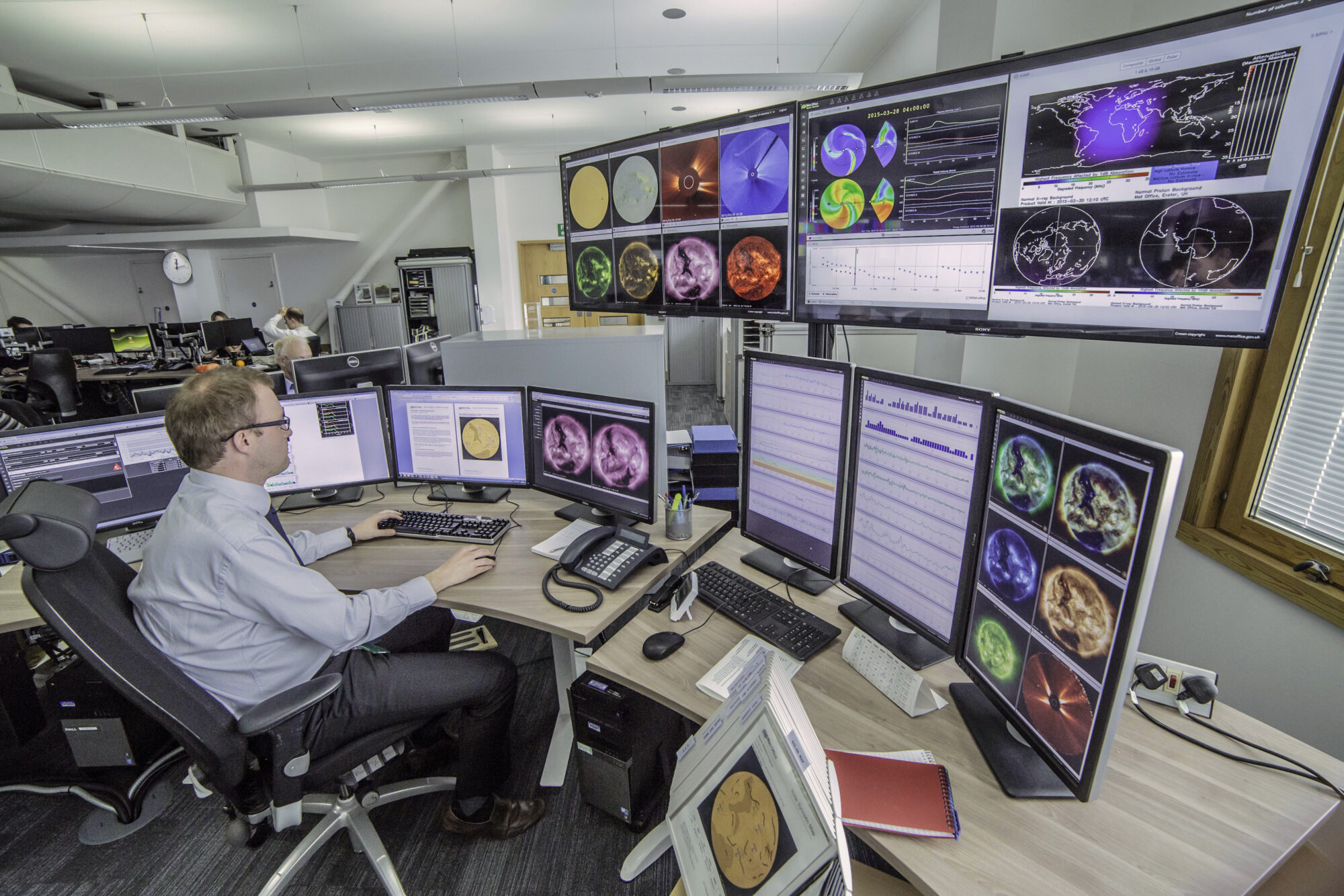
To support organisations in their risk planning, there is now more information available in terms of space weather monitoring and modelling capabilities than ever before from national organisations such as the UK’s Met Office, which provides a 24/7/365 active service, and international agencies including ESA.
Find out more
This is an extract from the latest issue of OpenSpace magazine. Subscribe to read the full version and more, including articles on digital twins, civil security from space and the unsung heroes of space missions, plus an interview with the Director of the Spanish Space Agency.
Main image: Future ESA Smile mission. Image © ESA/ATG medialab

