
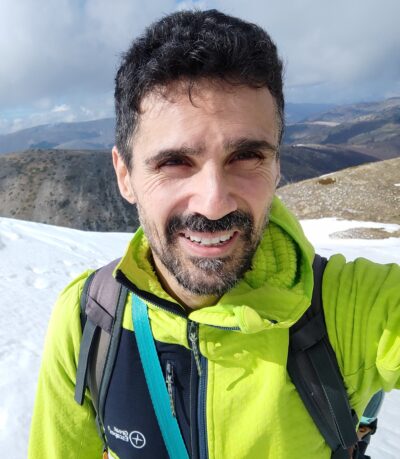
I’m an Earth Observation Processors Expert working on the EarthCARE and FORUM missions at the European Space Agency’s Centre for Earth Observation.
What’s your role?
I’m an Earth Observation Processors Expert based in Frascati near Rome, Italy, where I work at the European Space Agency’s Centre for Earth Observation (ESA ESRIN) in the Ground Segment and Earth Explorer Missions group. I have been working for the company for the last 3 years but my space sector career dates back 18 years.
What’s a typical day in your working life like?
I work on two ESA climate-related missions. One is the EarthCARE mission, for which I am a processors expert and data quality and exploitation engineer. I also work on the FORUM mission as an instrument engineer.
EarthCARE is in its operational phase: we access data, inspect and validate the data products, and develop tools for visualisation and scientific studies. FORUM is in its development phase, so our activities are focused on the design and analysis of the processing facility, the performance of its processors and expectations around the data.
I work with the software developers and scientific teams, and travel a few times a year for progress meetings or to attend conferences and workshops.
What do you enjoy most about your job?
I really enjoy working with satellite data and validating it. Another highlight is interacting with international scientists and experts, and having the opportunity to increase my knowledge by learning from them.
What has been your most memorable career highlight?
I was involved in the testing, verification and validation of all the EarthCARE processors – the satellite has four instruments on board and the processing chain is complex, given the synergies between the instruments. It was great to see that all the tested processors were correctly installed and operational in the ground segment, and that the EarthCARE satellite products released to the users by our processing chain worked well.
Do you have any tips for people trying to get jobs in your area of expertise?
Having a scientific background is important – for instance, Earth Sciences and Engineering courses will provide the background that helps with understanding what we work on.
But there are a lot of aspects to consider. For example, we work in international teams and it’s necessary to be able to communicate and interact with others: team-working is fundamental so you need to be collaborative and friendly.
Also, be curious and constantly update yourself on the ‘state of the art’ and technological frontiers. Think critically and creatively to overcome new challenges. Never stop learning.
How do you wind down?
Good question! I’m very energetic and quite sporty, so I do martial arts and cross-fit, and at weekends I organise treks with my ‘mountain friends’ or go diving with my instructors. During the week, in the evenings I enjoy a good glass of red wine. But the most important time is with my family, including studying and doing homework with my 11-year-old son.