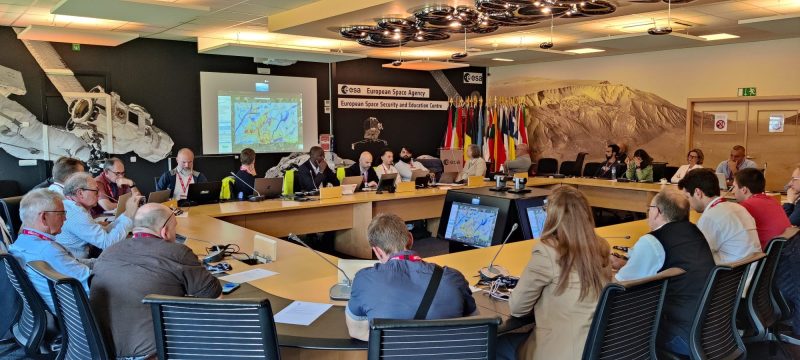
- A Starion-led consortium has successfully demonstrated the initial proof of concept for the SAFEPLACE platform, a next-generation crisis management solution to support civil security from space.
- The SAFEPLACE project is designed is to support fast, informed decision-making in the face of complex emergencies such as wildfires, floods, toxic chemical spills and earthquakes.
- This demonstration event was held the European Space Agency’s European Space Security and Education Centre (ESA ESEC) in Redu, Belgium, providing the infrastructure and technical support that were instrumental in enabling the SAFEPLACE proof of concept.

A consortium led by Starion Technologies BV has successfully demonstrated the initial proof of concept for the SAFEPLACE platform, a next-generation crisis management solution developed under ESA’s Civil Security from Space (CSS) programme. The demonstration was hosted at ESEC in Redu, Belgium, with the support of ESA and the Belgian Science Policy Office (BELSPO).
SAFEPLACE is designed to support civil protection and emergency response organisations by providing near real-time, actionable information during crises. The platform integrates a wide range of data sources – including satellite communications (satcoms), Earth observation imagery, IoT devices and a network of in-situ sensors – to create a comprehensive situational awareness environment.
Its mission is to support fast, informed decision-making in the face of complex emergencies such as wildfires, floods, toxic chemical spills and earthquakes. By fusing diverse data into a unified interface, SAFEPLACE will allow first responders and crisis managers to access critical information without the need for technical data expertise.
The consortium working on SAFEPLACE includes VITO, Epic Blue, VOCSens, neXat, ST Engineering, Centre Spatial de Liège, Public Safety Communication Europe (PSCEurope), the Bavarian Red Cross, Campus Vesta and Vodafone, with the support of the civil protection organisation safe.brussels.
Turning raw data into actionable insights
Alastair Pidgeon, Starion’s Principal Solution Architect, who is supporting the SAFEPLACE business strategy, said: “This is a very exciting project for the European community, and Starion and its consortium have the skills and expertise to deliver this project successfully.
“While commercial satellite constellations already offer timely Earth observation data, SAFEPLACE goes further by combining space-based and terrestrial data. It will apply artificial intelligence and advanced data fusion techniques to translate raw data into actionable insights. Most importantly, these insights could be delivered directly through existing platforms already used by emergency responders, eliminating the need to learn new systems during a crisis.”
Seliman Niakate, Starion’s SAFEPLACE Project Manager, said: “This first demonstration marks an important milestone. By integrating diverse data streams into one platform, we’re helping crisis responders gain a unified, real-time view of evolving situations, without requiring them to become data experts.”

Supporting crisis management with space data
SAFEPLACE has been developed to respond to the growing need for more agile, coordinated and data-informed crisis management capabilities, supported with near real-time information from space. It is engineered to tackle several systemic issues that hamper current response efforts:
- Delayed reporting and poor situational awareness
- Difficulty managing multiple simultaneous crises
- Fragmented and siloed information channels
- Lack of centralised communication and event logging
- Tension between data security and information sharing
- Complexity of integrating heterogeneous data sources.
The project is being supported by safe.brussels, which is responsible for coordinating and managing security in Brussels across safety disciplines to support the development of a cohesive regional security policy. Sophie Lavaux, Governor of the Brussels Conurbation and Director General of safe.brussels, said: “I believe that SAFEPLACE brings an unrivalled added value to the issue of efficient crisis management within large-scale environments. Combined with the operational core capabilities of ESEC, it will be instrumental in reaching a truly pragmatic solution for civil protection from space and on the ground.”
SAFEPLACE is made possible through support from ESA’s CSS programme, which seeks to increase the uptake of space data for civil security applications, and BELSPO, Belgium’s Science Policy Office, in charge of managing the Belgian contributions to international space programmes. BELSPO plays a central role in representing Belgian interests in European space initiatives, managing Belgium’s contributions to ESA and supporting innovation across academia, research and industry.
Frank Monteny, Director General Research and Space at BELSPO, added: “Belgium has been a strong supporter of the Civil Security from Space (CSS) programme since its very first steps in 2022. The SAFEPLACE initiative perfectly embodies the CSS spirit by integrating satellite connectivity, Earth observation and ground-based systems. It highlights how upstream and downstream space industries can join forces with non-space sectors and civil security stakeholders to deliver commercial solutions. SAFEPLACE is a powerful example of how space technology can help solve real-world challenges and make a meaningful impact on our society.”
Cybersecurity for civil security
This early demonstration event was held at ESEC, an ESA facility that supports satellite operations, cybersecurity and space education. ESEC’s infrastructure and technical support were instrumental in enabling the SAFEPLACE proof of concept.
Jean-Luc Trullemans, Head of ESEC, said: “It is in this approach to civil security that the major dimension of cybersecurity must be added, which fully involves the European Space Security and Education Centre in Redu to support the deployment of CSS. ESEC is the only centre within the Agency that meets the strictest security standards, including the requirements set by Belgium and the European Union. ESEC is also completing construction of its Cybersecurity Centre (ECSC), which meets the strictest standards for handling classified information.
“The solutions developed by the Agency will offer cutting-edge cybersecurity, capable of guaranteeing the protection of equipment, services and data that meets the challenges. As such, the site is the essential partner of crisis managers, a “security producer” capable of guaranteeing the trilogy of confidentiality, integrity and availability.”