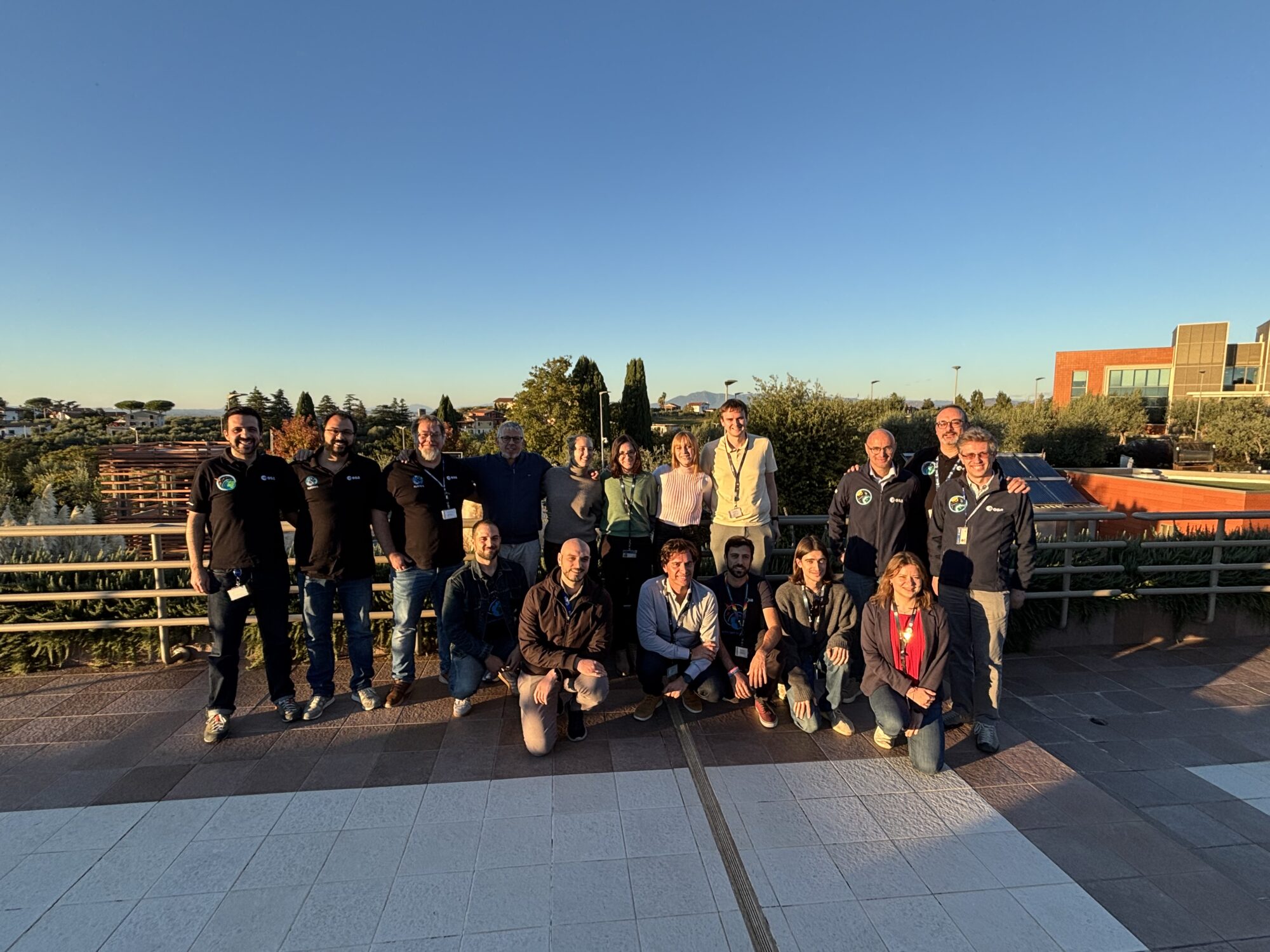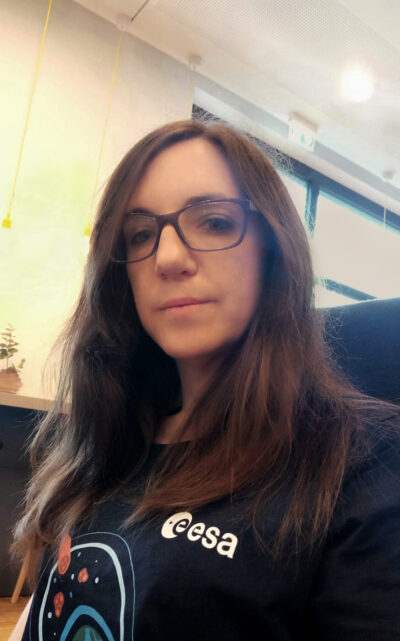
I’m an Operations Engineer at the Near-Earth Object Coordination Centre at ESA ESRIN, within the Planetary Defence Office, but I’m a Mathematician at heart.
What’s your role?
I work in the European Space Agency’s Centre for Earth Observation (ESA ESRIN) in the Near-Earth Object Coordination Centre (NEOCC) as an Operations Engineer.
What’s a typical day in your working life like?
My work focuses on the dynamics of near-Earth asteroids (NEAs). Together with two colleagues, I work on computing their orbits and assessing the risk of their impact with Earth. I collaborate closely with astronomers who observe asteroids and with the team responsible for publishing data on the NEOCC portal. We also interact frequently with external companies, institutions and agencies.
My working days are very varied: they range from monitoring and validating software and results to developing new ideas, attending technical and scientific meetings (both internal and external) and supervising the work of interns and thesis students who come to our centre. The job also involves a significant amount of travel, within Italy, across Europe and sometimes beyond, for project meetings, conferences, workshops and exchanges with groups carrying out similar work.
What do you enjoy most about your job?
What I enjoy most is that my job combines a strong technical component with organisational and management aspects, as well as continuous interaction with very different professional profiles.
My job is extremely varied and stimulating, and sits right at the heart of the planetary defence problem. I find it fascinating because it allows me to use what I studied on a daily basis, while at the same time requiring constant learning, updating my existing skills and the development of new skills.
What has been your most memorable career highlight?
There hasn’t been a single standout moment. What I find truly remarkable is having witnessed the evolution of the Centre over time.
When I started, we were just three people managing a portal whose data was produced by software developed by a university many years earlier. Today, we are nine people on site, plus six more across other ESA locations.
The NEOCC has become fully integrated and officially recognised within the international scientific community, and we rely on software that is fully developed in-house, which we manage ourselves and has become increasingly capable of providing the data we need. I have been involved in the development of this software since its very beginning and this is something I am particularly proud of.
Do you have any tips for people trying to get jobs in your area of expertise?
This is a field where passion is essential. It is also highly interdisciplinary and includes disciplines such as astronomy, mathematics, computer science, statistics and engineering. A strong educational background is important, but so are motivation, curiosity and the willingness to keep learning.
Planetary defence is a rapidly evolving field and requires the ability to work effectively in multidisciplinary teams.
How do you wind down?
I don’t really have time to wind down after work, as I have a two‑and‑a‑half‑year‑old daughter. That said, she has an amazing ability to make me completely disconnect from work – even though, to be fair, asteroids don’t follow office hours, and alerts sometimes arrive at the most unexpected moments!
Laura’s asteroid
In January 2026, ESA announced that Laura was one of a small select group of people to have an asteroid named after her in 2025, alongside nine other people and places. (126247) Laurafaggioli was named after Laura for her work on asteroid orbit determination and risk assessment for ESA’s Planetary Defence team.